
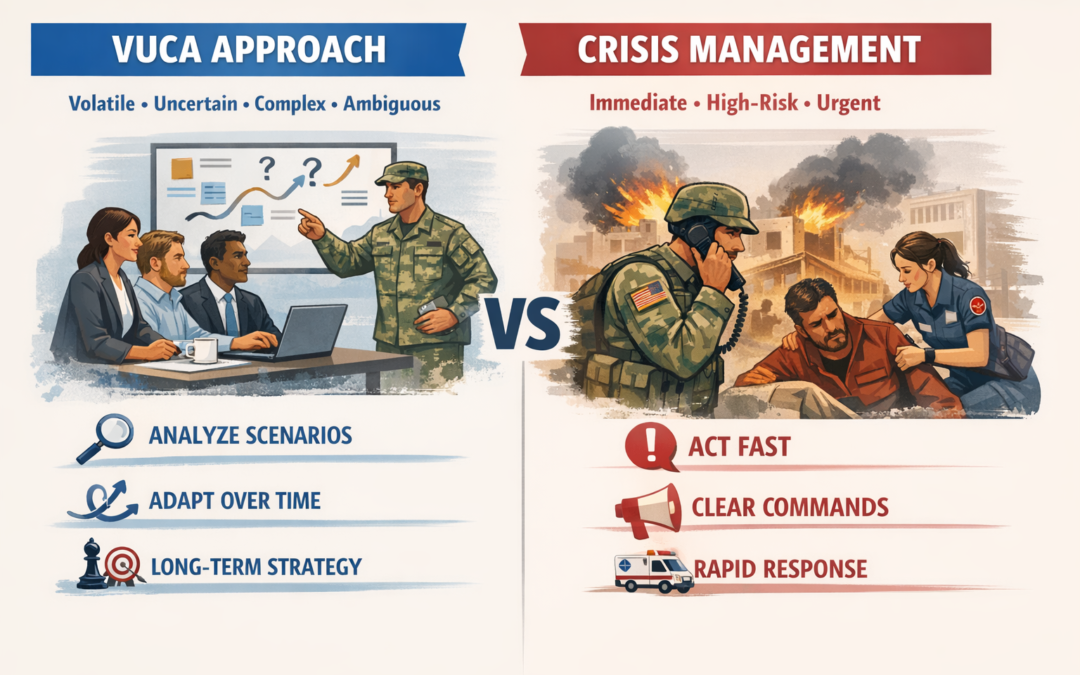
With the recent escalation of conflict in the region, I’ve noticed some people advocating the use of “VUCA” model.” It’s an easy label to reach for when things feel uncertain. But it’s worth asking a simple question: are we using the right framework for what’s actually happening?
VUCA stands for Volatility, Uncertainty, Complexity, and Ambiguity. It was first introduced by the military, after the Cold War, to describe a world that had suddenly become less predictable. The clear lines between allies and enemies had blurred, conflicts became less structured, and information was often incomplete. In response, military leaders were trained to think differently — not to rely on rigid plans, but to stay flexible, adapt quickly, and make decisions based on intent rather than detailed instructions.
I was first introduced to VUCA around four years ago, in 2022, while studying for the AgileSHIFT certification. At the time, it stood out as a simple but powerful way to describe the kind of environments many organizations operate in today. It helped frame uncertainty in a structured way and offered a practical mindset for navigating change — which is why it has stayed relevant in many transformation discussions since.
Over time, VUCA moved into business and government, where it proved very useful. It helped leaders deal with changing markets, digital disruption, and large transformation programs. It encouraged flexibility, awareness, and the ability to adjust direction as situations evolved.
But what we are seeing today in parts of the Middle East, with an ongoing war and rising tension, is different.
VUCA assumes that you still have some time to think, assess, and adjust. It works best when leaders can step back, look at different scenarios, and make decisions as new information becomes available. Even in uncertain conditions, there is still room to interpret and respond over time.
In contrast, the current situation in conflict areas is immediate and high-risk. Decisions are not made after careful analysis or multiple scenarios. They are made quickly, often under pressure, where safety and speed matter more than perfect understanding.
This is not just uncertainty. It is urgency.
In moments like this, the focus shifts. It becomes less about understanding a complex situation, and more about taking clear and fast action. Approaches based on crisis management, rapid response, and clear decision-making structures become more useful than frameworks designed for longer-term thinking.
This doesn’t mean VUCA is wrong. It remains a powerful way to understand change in many business and government settings, and even in its original military use, it was meant to help leaders adapt to evolving situations — not to respond to immediate threats in real time.
But it doesn’t apply to every situation. Using it in the wrong context can slow things down when quick decisions are needed.
Strong leadership is not just about knowing frameworks. It’s about knowing when to use them — and when not to.