
In a previous experience, I worked with an organization that repeatedly struggled with one basic question: who should pay for digital systems once they are implemented?
Getting approval for project CAPEX was challenging but usually achievable. The real problem started after go-live. Licensing fees, cloud costs, support contracts, and system maintenance all required OPEX. At that point, progress slowed down.
Each budget cycle turned into a debate between Business and IT. Business teams argued that IT owned the systems. IT teams argued that the systems existed to serve business needs. No clear answer meant delays, especially for system updates, enhancements, and security fixes. Funding disagreements became the main reason work stalled.
This was not a budget issue. It was a design flaw in the operating model.
The Real Problem: No Clear Owner for Ongoing Costs
In many organizations, IT is set up as a delivery and support function. It builds systems, keeps them running, and ensures technical stability. Business teams, on the other hand, define requirements and expect results.
The issue arises when:
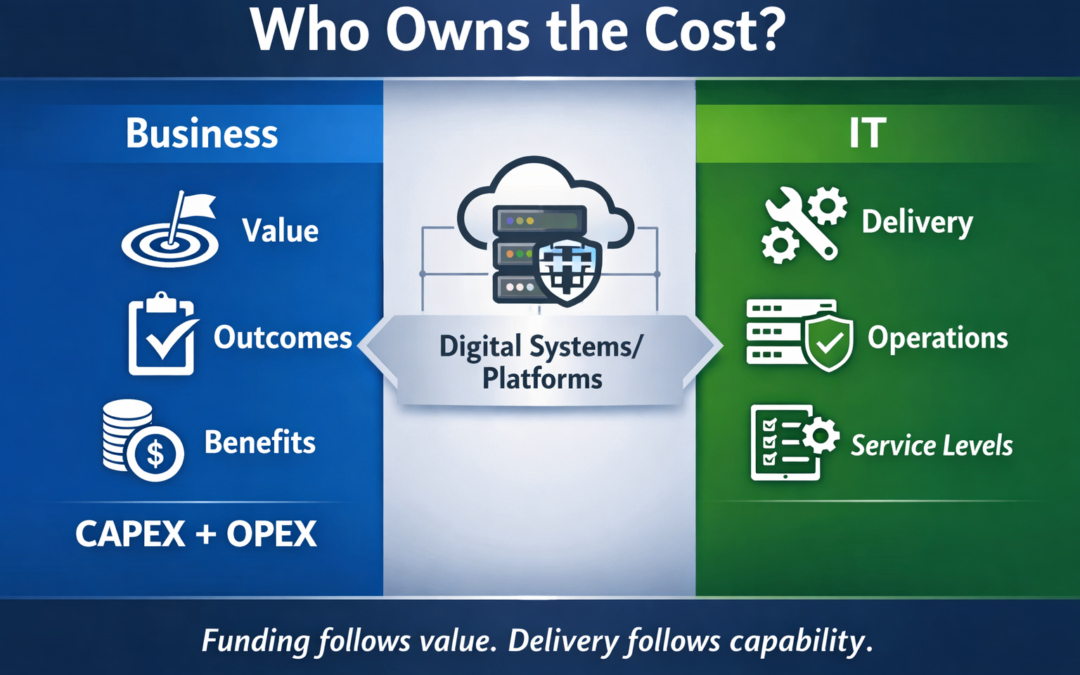
- Business owns the outcomes
- IT owns the delivery
- No one clearly owns the ongoing cost
Well-run organizations avoid this confusion. Industry best practices in product-based and value-stream operating models are very clear: the function that benefits from a system should fund it across its full lifecycle.
What This Causes in Practice
When funding accountability is unclear, the consequences are predictable.
System upgrades are postponed. Enhancements are delayed. Security patches wait for approvals. Over time, systems fall behind, risks increase, and frustration grows between Business and IT leaders.
More importantly, digital transformation loses momentum. Systems are treated as one-time projects instead of long-term business assets that need continuous investment.
How It Should Be Handled
The solution is simple, even if the change is not.
Business functions should fund the full lifecycle of the systems they rely on, covering everything from initial implementation to licenses and ongoing operating costs. IT, in turn, should be funded to deliver and operate these systems as services, based on clearly agreed service levels, architectural standards, and performance expectations. To support this model, transparent chargeback mechanisms help create cost awareness and accountability, without positioning IT as a profit center.
This approach:
- Speeds up decision-making
- Makes priorities clearer
- Reduces conflict between Business and IT
- Allows IT to focus on delivery rather than budget defense
This approach shifts the conversation from “who pays?” to “what value are we sustaining or enhancing?”—a far more productive discussion.
A Design Issue, Not a Budget Issue
When funding becomes the main source of conflict and delay, it is rarely a financial problem. It is almost always a design problem—in operating model, governance, and accountability.
Organizations serious about transformation must address this upfront. Otherwise, even the best strategies will stall—not due to lack of vision, but due to unresolved ownership at the most fundamental level.